


Many conversations about AI in the disability sector start with efficiency. Providers carry a heavy administrative load, so the natural first move is to use AI for the administration tasks that are most onerous. While that is one way for AI to deliver value, it undersells the potential for AI to improve the quality of support delivered and create a positive impact for participants.
Minikai is an Australian AI-based platform designed for the human services sector, built by a team with strong backgrounds in delivering disability support and in AI, and co-designed with the providers who use it. Minikai has a person-centred design, where each participant has a Mini, an AI advocate (agent) that has a vast array of data on the individual, spanning years and drawn from the multiple systems a provider uses.
This allows the Mini to assist with a wide range of tasks, from surfacing a participant's support needs to a support worker, to showing a quality manager how that person has been supported to make their own decisions over time.
Through aligning AI capabilities with individuals as opposed to rigid workflows, AI is empowered to improve the quality of support. Because the Mini stays with the person across goal planning, service delivery, documentation and analysis for improvement, the Mini connects the dots and surfaces relevant information to the user about the participant.
This whitepaper explains how disability service providers that have embedded Minikai into their operations have seen quality improve at each stage of the quality cycle.
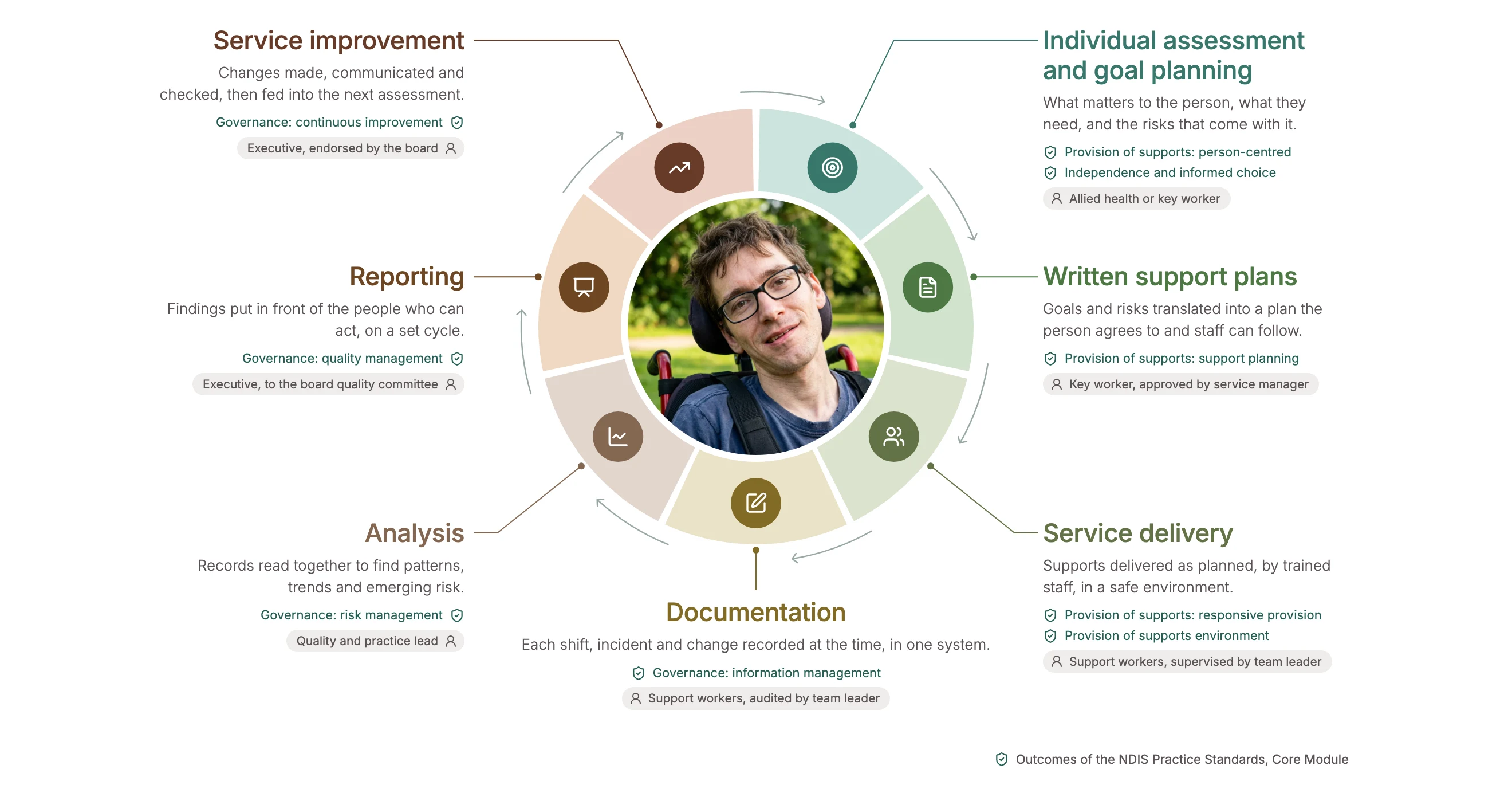
The person-centred quality cycle
The diagram shows seven stages where Minikai improves quality, anchored to the participant. Each stage is mapped to the NDIS Practice Standards, with the key accountable roles identified.
Individual assessment and goal planning
Who: Allied health professionals (AHPs), house coordinators
NDIS Practice Standard: Rights and Responsibilities
The house coordinator works with the participant and their family to determine their individual goals. To inform that conversation, a Mini scans large numbers of existing records to show how the person is progressing against their current goals, or, for a new participant, draws on intake files, previous reports and recorded interviews. Bringing this evidence together gives everyone involved the same picture of the person.
Allied health professionals (AHPs) assess the support needs of the individual, and the type of support required for them to achieve their goals. A Mini collates records such as notes, incidents and shift reports to inform the AHP on progress since the last assessment, with the records cited as evidence to refer to. The goals and assessments are used by an NDIS planner to develop a budget to support the participant to achieve their goals. Once the plan is approved by the NDIS, sent to the participant, and shared with the provider, a Mini can draft the service agreement from it.
Minis can also surface records that show the changing needs of a participant, which the provider can use to request a plan reassessment under section 48 at any time, not just at the scheduled review. In each case, Minis give everyone involved the same view of the whole person, backed by evidence.
Written support plans
Who: Allied health professionals, house coordinators
NDIS Practice Standard: Provision of Supports
A support plan sets out how an individual should be supported (physically, communicatively, environmentally and cognitively) to maximise their independence through routine day-to-day tasks, new opportunities and new environments. It needs to be practical enough to follow on shift and kept current as the person changes.
AHPs and house coordinators can ask Minikai to draft a support plan in the provider's template from the participant's goals and relevant specialist reports (stored in the participant's Mini). Review of support plans also occurs seamlessly. Minikai will review shift notes over any given period and compare this with the last support plan written to highlight any changes that require review and documentation. The author decides what goes in. A plan built this way is easier for a new worker to follow and easier to stand behind at audit, because every line traces back to evidence.
Service delivery
Who: Support workers, team leaders
NDIS Practice Standard: Provision of Supports Environment and Provision of Supports
Good outcomes in a supported independent living (SIL) setting depend on knowing the person. Research on supported accommodation (Bigby and Beadle-Brown 2018) links better quality of life outcomes to staff practice, in particular active support: giving each person the right amount of help to take an active part in everyday activities and relationships. With several workers covering one participant across a week, and often high volumes of casual and agency support staff, continuity of care and access to timely information are critical and often difficult to support.
A frequently performed task on Minikai by frontline staff is to obtain a general overview of the person: who they are, what matters to them, how they communicate, and the type of support required. This is drawn from their support plans and recent notes and cited to the source.
Providers also use the Minikai workspace agent to produce shift plans for all residents in a house. Drawing on each resident's plans and recent notes, a shift plan sets out what each person has on that day and the level of support recommended to enable their active participation. Each worker starts the shift knowing how to support every resident to be involved.
Documentation
Who: Support workers, allied health professionals, team leaders
NDIS Practice Standard: Provider Governance and Operational Management
Documentation such as shift notes, incident reports, charts and allied health notes are the evidence that justifies funding, shows when support needs are changing and underpins evidence-based practice for the participant. At an organisational level, aggregation of this information across individuals can provide valuable insights into trends, service needs and changes in the case mix of participants.
Capturing detailed information in regular documentation places significant administrative burden on service teams. Conversations with many providers show that the requirement for detailed notes often leads to one of two outcomes: additional out of hours work to complete quality notes, or less than optimal quality to finish work on time. This is an area of improvement that many SIL providers are clearly and currently focussed on.
A Mini relies on input from a person to write documentation, so the account of events stays accurate. A Mini can turn a spoken account of a shift or a therapy session into a note or an incident report and help structure it in the format the provider requires, such as SBAR or SOAP. This ensures that notes are captured consistently across the organisation and in the right format.
Data quality gains are measurable. Previous research at one provider found that notes nurses wrote with Minikai were more complete against SBAR format than when Minikai was not used.
A Mini also assists the author in understanding what the record needs, such as irregular supports that can later be claimed, whether the response to a behaviour of concern followed the person's behaviour support plan, how the person was supported to make a decision, and how they took part in activities toward their goals. If a support worker describes something that is an incident without realising it, the Mini can point them to the provider's incident procedures and bring up the incident reporting template.
Analysis
Who: Quality and practice leads, house coordinators, managers
NDIS Practice Standard: Provider Governance and Operational Management
The ability of users to draw insights about a behaviour, an incident, a service or an outcome is transformed when data from multiple fragmented systems comes together in an individual's Mini.
An example of this was recounted by a provider.
When a reportable incident occurred in a SIL home, rather than follow the usual line of inquiry with interviews of relevant stakeholders (taking over a week), an analysis of records over three months showed that the behavioural incident occurred after a progressive increase in signs of physical discomfort in the participant's health charts.A SIL provider using Minikai
No single worker had seen both an increase in pain and an increase in behaviours, because each only had a shift view of the person. The Mini pulled the records together over the three months, creating a new picture of what was occurring, and did this within 30 minutes, resulting in an immediate medical appointment which resolved both issues.
The Minikai workspace agent facilitates this same analysis across multiple individuals (Minis), such as everyone in a home or service.
Quality leads also use Minikai to find the root cause of incidents and identify opportunities for further workforce training. The Minikai workspace agent has been used by organisations to understand how staff members work with individual participants and through this internal review process, often identify the need for more training or supervision. Identifying trends and gaps in information and compliance is especially relevant to audits. With identification being the first step, determining if the issue is systemic or a local issue directs the improvement activity and planning.
Reporting
Who: Quality and practice leads, managers, executives
NDIS Practice Standard: Provider Governance and Operational Management
Regulations and compliance requirements are continuing to expand in SIL services. Managers and executives need to understand what is happening across their services to make informed decisions which inevitably impact service delivery and quality of outcomes. Pulling this complex and fragmented data together has been resource intensive and has often been bottlenecked with data analytics teams who are under the pump to make sense of data from multiple sources across the organisation.
The Minikai workspace can hold key reference documents, organisational policies and procedures to ensure that all documentation produced references the organisation's way of working. This means that reports highlighting strengths and risks within an organisation's compliance, incident management and goal measurement, as examples, can be produced when needed, without waiting until a dashboard is updated at month end. Leaders have improved visibility of their services and so can manage more proactively.
Service improvement
Who: Executives, quality and practice leads
NDIS Practice Standard: Provider Governance and Operational Management
Where analysis and reporting have identified trends, their root causes and areas for improvement, Minikai facilitates the improvement process. That means drafting policies and procedures, communicating the changes to staff, and monitoring whether practice has changed.
Minikai supports each step. Minikai can draft new policies and procedures from what the reporting found, ensure alignment with NDIS quality and practice standards and ensure a summary of the changes for staff and families is written using the right language. Once reviewed, the updated policies become part of the context every Mini works from. Support workers then see the new procedure at the point it applies.
The Minikai workspace agent can compare what is documented in the notes against the updated policy and provide evidence of whether the change has been effectively communicated and translated into practice. This can occur at the individual level or at a group level.
Why the cycle matters
Each stage warrants attention. The framework is useful to demonstrate how each stage impacts the next. Individualised assessment and support, documentation, analysis and reporting drive continual improvement. Audit readiness stops being a separate project, because the evidence an auditor asks for is the same record the provider already uses to support individuals.
Throughout, the decisions remain with people: the participant, their family, and the people involved at each stage. The Mini's role is to make sure that when they decide, they have the person's whole story in front of them.
For further information, get in touch with us.
Download the whitepaper Quality in Supported Independent Living, PDF, 4.4 MB